July 30, 2026
Inside OpenAI's Advertising Platform: What Brands Need to Know
For years, OpenAI insisted advertising had no place in ChatGPT. In 2026, that changed — and it changed fast. What started as a cautiously worded "testing phase" in January has, within six months, become a self-serve advertising platform at ads.openai.com with agency partners, published pricing, and campaigns already running for national brands. Here's what actually happened, and what it means for anyone thinking about visibility inside ChatGPT going forward.
For years, OpenAI insisted advertising had no place in ChatGPT. In 2026, that changed — and it changed fast. What started as a cautiously worded "testing phase" in January has, within six months, become a self-serve advertising platform at ads.openai.com with agency partners, published pricing, and campaigns already running for national brands. Here's what actually happened, and what it means for anyone thinking about visibility inside ChatGPT going forward.
From "last resort" to a live ad platform in six months
OpenAI confirmed on January 16, 2026 that it was beginning to test ads in the U.S. for logged-in adult users on the Free tier and the newly launched ChatGPT Go tier ($8/month) (Monks, 2026). The first confirmed live placements were identified by ad-intelligence firm Adthena on February 9, 2026 (ALM Corp, 2026). By July 22, 2026, OpenAI had opened "Advertise in ChatGPT" as a fully self-serve Ads Manager, with Best Buy, Lowe's, and VistaPrint already running campaigns through it (explainx.ai, 2026) — a pace one analysis described as looking less like a cautious experiment and more like a company racing to establish a second revenue line before competitors could react (tech-insider.org, 2026).
How the ads actually work
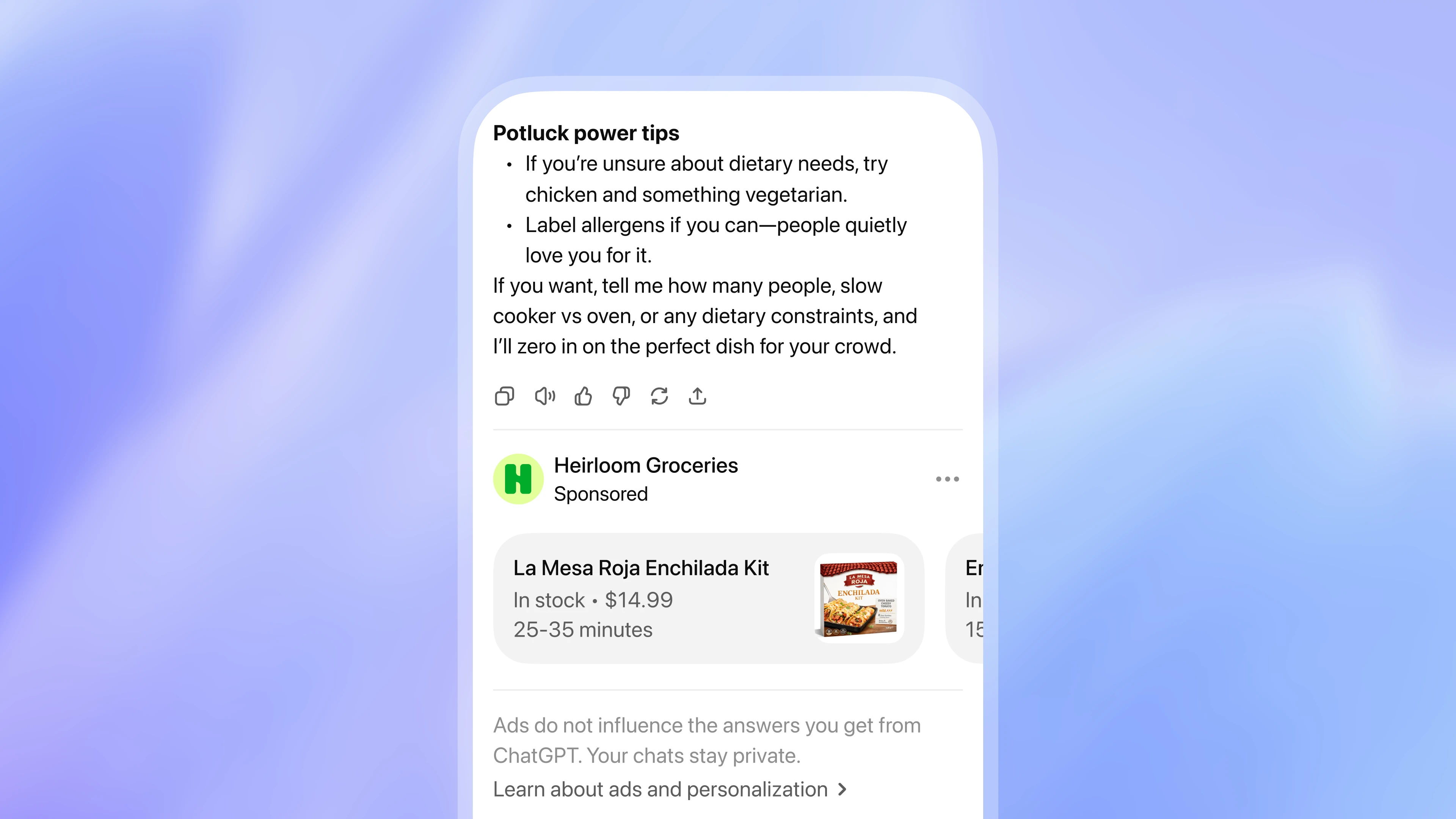
Per ads.openai.com and OpenAI's own help documentation, ads appear as clearly labeled, visually separated placements — described across sources as contextual text ads or subtly tinted boxes at the bottom of a chat response, never inside the answer itself (Monks, 2026; 2pointagency, 2026). OpenAI states organic answers are generated independently of advertising and that ads do not influence what ChatGPT actually tells a user (ads.openai.com, 2026) — though as one industry summary noted, whether that separation holds as revenue pressure increases "remains to be seen" (leanware.co, 2026).
Targeting is contextual — based on the current conversation and prior ad interactions — rather than the keyword-bidding model familiar from Google Ads (2pointagency, 2026). OpenAI states it does not sell conversation data to advertisers, and gives users controls to turn off ad personalization or clear ad-related data (Monks, 2026). Paying subscribers — Plus, Pro, Team, Business, Enterprise, and Education — remain ad-free; only Free and Go-tier users, and only in the countries where ads have launched, see them (ALM Corp, 2026).
Pricing moved fast, and downward
Initial access ran through an invite-only enterprise model: roughly $60 CPM with a $200,000 minimum commitment, a price point about three times Meta's average rate at the time (ALM Corp, 2026; mexc.com, 2026 — which put Google's comparable CPM near $38). Within about twelve weeks, that model had flipped to a self-serve CPC auction with a $50,000 minimum (tech-insider.org, 2026), and by May 2026, the self-serve Ads Manager was reportedly taking both CPC and CPM bids with no minimum spend requirement at all (2pointagency, 2026) — a rapid democratization from "enterprise-only beta" to "credit card and go."
Rollout has been uneven, and still is
Ad penetration inside actual ChatGPT responses has been volatile rather than a smooth ramp. One tracking analysis measured penetration at just 0.42% of U.S. responses in April–May, spiking to 26.5% by late May (49.1% within the U.S. specifically), dropping to under 1% in mid-June, then re-ramping from late June to stabilize around 51% of U.S. responses, 54% in Canada, 50% in Australia, and 19% in Japan by early July (cloro.dev, 2026). Geographically, the initial rollout was limited to seven markets — Australia, Canada, Japan, Korea, New Zealand, the UK, and the U.S. — which one Hacker News estimate cited in that same analysis calculated as roughly 8% of world population but closer to 38% of global nominal GDP, consistent with a deliberate first wave aimed at markets with real advertiser budgets rather than a global launch (explainx.ai, 2026).
The revenue numbers OpenAI is chasing
Reporting cited by cloro.dev's rollout analysis put OpenAI's internal projections at $2.5 billion in ad revenue for 2026, $11 billion by 2027, and $100 billion by 2030 — with one industry deck estimate specifically attributing $46 billion of that 2030 figure to free-tier advertising revenue alone. Wall Street is notably less bullish: Evercore ISI analyst Mark Mahaney published a January 2026 estimate projecting ChatGPT advertising as a $25 billion annual business by 2030 — about a quarter of OpenAI's own internal figure, though as the same analysis points out, still a genuinely large business by any external measure. Separately, broader market forecasting cited by mexc.com put total brand spending on AI-search advertising (not OpenAI-specific) at $2.08 billion in 2026, rising to $25.93 billion by 2029.
Guardrails — and where they've already loosened
At launch, OpenAI's ad policy excluded political, health, and mental-health-adjacent contexts from ad placement entirely, alongside a standing ban on dating, alcohol, drugs, and gambling as ad categories, and a system designed to block ads for accounts it believes belong to minors (tech-insider.org, 2026). That policy has already moved once: an April 2026 update removed the blanket exclusion around medical, legal, and financial advice contexts specifically, while keeping the guardrails around politics and mental health in place (tech-insider.org, 2026) — an early signal that the initial, more conservative boundaries are negotiable as the ad business matures.
Not everyone welcomed it
The move drew direct public criticism from a competitor. Anthropic aired a Super Bowl commercial in February 2026 — reported to have cost around $8 million for the 30-second spot — depicting a chatbot interrupting advice with product promotions, a direct critique of OpenAI's advertising plans (mexc.com, 2026). OpenAI CEO Sam Altman publicly called the ad "deceptive" and said his company respects its users (mexc.com, 2026).
What this means if you're trying to be found in ChatGPT
Two things worth separating clearly. First, this is a paid, labeled channel that sits below the organic answer — it does not change how ChatGPT decides what to say about a brand unprompted, at least based on OpenAI's own stated design. Second, and more strategically important: OpenAI's own ad platform is itself evidence of how much commercial weight is now moving through conversational AI — with brands like Best Buy already running live campaigns and citing early results as a reason to "stay relevant and top of mind" in a channel where, in Best Buy's own framing, people increasingly go specifically "to research and make decisions" (ads.openai.com, 2026). Earning the organic, unpaid recommendation remains the harder and more durable win — but the fact that a paid lane now exists at all confirms the channel has become commercially serious enough to build a $100 billion internal projection around.
References
- ALM Corp, "ChatGPT Ads Launch in February 2026," Feb 2026
- Monks, "The Answer Engine Battles: Navigating the ChatGPT Ad Rollout," 2026
- explainx.ai, "ChatGPT Ads Launch — OpenAI Ads Manager 2026," July 2026
- leanware.co, "ChatGPT Ads Are Coming," Jan 2026
- 2pointagency, "ChatGPT Advertising: The Complete 2026 Guide"
- tech-insider.org, "ChatGPT Ads Hit 51% of US Replies, Live in 6 Nations," 2026
- cloro.dev, "Does ChatGPT Have Ads? ChatGPT Ads Rollout Status in 2026"
- mexc.com / crypto.news, "OpenAI Challenges Google and Meta Ads With ChatGPT Advertising Platform," Jan 2026
- mexc.com / crypto.news, "Anthropic Targets OpenAI With Super Bowl Ad Over ChatGPT Advertising Plans," Feb 2026
- ads.openai.com, OpenAI Ads product page, accessed July 2026